


- Women lose collagen in sudden bursts, not gradually. Research shows major biological shifts at around age 44 and again at 60.
- Menopause can cause a loss of up to 30% of skin collagen within just five years, driven by the rapid decline in oestrogen.
- Collagen loss is systemic. The same process that thins skin also weakens bones, blood vessels, and spinal discs.
- UV exposure, dietary sugar, and chronic stress actively accelerate collagen breakdown through distinct biological pathways.
- A multi-pronged approach combining sun protection, nutrition, stress management, and targeted supplementation offers the strongest support.
Your skin is more honest than you might think. The firmness you notice changing in the mirror reflects something much deeper: a structural shift happening across your entire body.
What collagen actually does in your body
Collagen is the most abundant protein in the human body. It provides structural strength and elasticity to the skin, bones, cartilage, blood vessels, and connective tissue. Think of it as the scaffolding that holds everything together.
From around age 30, your body's collagen production begins to slow, declining by roughly 1% per year. For the first decade or so, this decline is subtle. But it does not stay that way.
Why does collagen loss accelerate at specific ages?
For a long time, scientists assumed aging was a smooth, gradual process. A landmark 2024 study from Stanford University, published in Nature Aging, changed that understanding.
The researchers tracked 108 participants over several years, analysing over 135,000 distinct molecules from blood, skin, and microbiome samples. Their finding was striking: 81% of the biological molecules they measured did not change gradually at all. Instead, they shifted dramatically at two specific points, around age 44 and around age 60.
The first wave, around 44, involves rapid changes in lipid metabolism, cardiovascular markers, and inflammatory pathways. For women, this period often overlaps with perimenopause, compounding the biological shift with the initial decline in oestrogen. The result is a noticeable acceleration in skin changes, reduced muscle mass, and metabolic slowing.
The second wave, around 60, brings deeper structural changes. Collagen levels can fall below 60% of their youthful baseline, driven by a significant reduction in the fibroblast cells that produce collagen, combined with decades of accumulated environmental damage.
The menopause factor: why women are uniquely affected
Oestrogen is one of the body's most important regulators of collagen production. It stimulates the cells that build new collagen, helps maintain hyaluronic acid levels for skin hydration, and keeps the enzymes that break collagen down in check.
When oestrogen levels drop during menopause, all three of these protective mechanisms weaken simultaneously. Clinical data shows that women can lose up to 30% of their skin collagen within the first five years post-menopause, at a rate of roughly 6% per year. After this initial period, the loss continues at a slower but still elevated pace of 1 to 2% annually.
This is what makes collagen loss in women fundamentally different from what men experience. Men lose collagen too, but at a steadier, more predictable rate. Women face a concentrated period of rapid depletion directly tied to hormonal change.
It goes far beyond skin
Here is something that deserves more attention: the collagen in your skin is structurally identical to the collagen in your bones, your blood vessels, and your spinal discs. They are all built from the same Type I and Type III collagen fibres.
Research confirms that menopause affects all of these tissues through the same mechanism. As skin thins, arterial walls thin too. As dermal collagen degrades, bone mineral density drops because the collagen scaffolding that calcium crystallises onto is weakening. Spinal discs lose hydration and structural integrity.
What you see in the mirror, the fine lines, the loss of firmness, is an external signal of something systemic. Visible skin aging can be understood as a biomarker for broader structural change throughout the body.
Three lifestyle factors that accelerate collagen breakdown
Beyond age and hormones, three external factors significantly speed up collagen degradation:
UV radiation is the most aggressive external threat. Sunlight directly damages the collagen triple-helix structure and triggers the release of enzymes (matrix metalloproteinases) that actively break collagen fibres apart. Decades of unprotected sun exposure can cause the rate of destruction to far outpace any remaining production capacity.
Dietary sugar and processed foods drive a process called glycation, where excess glucose bonds to collagen fibres, making them stiff and brittle. These Advanced Glycation End-products (AGEs) also trigger chronic low-grade inflammation that further degrades the matrix.
Chronic stress and poor sleep elevate cortisol, a hormone that directly suppresses collagen production at the genetic level. Research shows that cortisol downregulates the specific genes responsible for producing Type I and Type III collagen. Sleep disruption compounds this by halting the nocturnal repair processes your skin depends on.
What can you actually do?
The science points to a multi-pronged approach. No single intervention addresses all the pathways involved, but several strategies working together can make a meaningful difference.
Protect your skin from UV damage every day. Consistent sunscreen use is the single most impactful thing you can do to slow extrinsic collagen degradation. This is non-negotiable at any age.
Support collagen formation from the inside. Your body needs specific building blocks to produce collagen. Vitamin C is essential, as it is a required cofactor in collagen synthesis. A protein-rich diet provides the amino acids that form the collagen structure. Hydrolysed collagen peptides have shown promising results in several clinical trials, with improvements in skin hydration, elasticity, and bone mineral density markers in postmenopausal women.
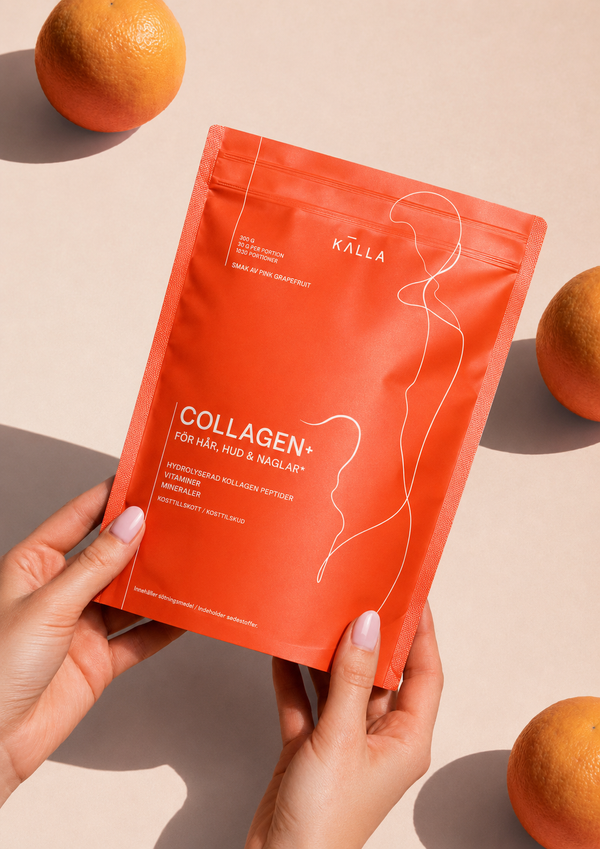
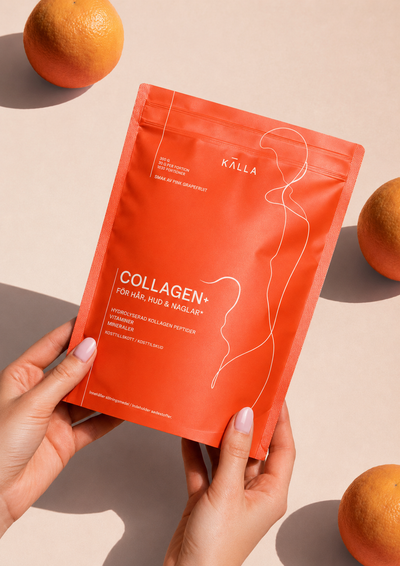
Collagen+ from KÄLLA combines 7,500 mg of hydrolysed collagen peptides with hyaluronic acid, Vitamin C, biotin, selenium, and zinc, a multi-nutrient approach designed to support skin, hair, and nail health from within. Vitamin C in the formula contributes to normal collagen formation, while the antioxidants help protect cells from the oxidative stress that accelerates visible aging.
Manage stress and prioritise sleep. Reducing chronic cortisol exposure helps preserve the genetic pathways that drive collagen synthesis. Your skin does its repair work at night, so consistent sleep architecture matters.
Consider your nutrition beyond supplements. Reducing processed sugar intake limits the glycation that stiffens collagen fibres. A diet rich in antioxidants, omega-3 fatty acids, and quality protein creates the metabolic environment your body needs to maintain connective tissue.
A note on honesty
We believe in being transparent. While clinical trials on oral collagen peptides have shown encouraging outcomes for skin and bone health, major dermatological bodies like the American Academy of Dermatology have noted that the evidence remains mixed. Many positive studies have been industry-funded, and independent trials have not always replicated the same results.
What the research does consistently support is that a holistic approach, combining sun protection, good nutrition, adequate Vitamin C, stress management, and quality sleep, forms the strongest foundation for preserving collagen. Supplementation works best as part of that broader strategy, not as a replacement for it.
Your body is remarkably capable of maintaining itself when given the right support. The key is starting where you are, with what you can influence today.
Scientific Sources
- Shen, X. et al. (2024). Nonlinear dynamics of multi-omics profiles during human aging. Nature Aging, 4, 1619–1634.
- Brincat, M. et al. (2005). Long-term effects of menopause and sex hormones on skin thickness. British Journal of Obstetrics and Gynaecology, 112(8), 1432-1437.
- Brincat, M. & Calleja-Agius, J. (2007). The skin, carotid and intervertebral disc: making the connection! Climacteric, 10(sup2), 21-24.
- Varani, J. et al. (2006). Decreased Collagen Production in Chronologically Aged Skin. American Journal of Pathology, 168(6), 1861-1868.
- Lephart, E.D. (2016). Managing Menopausal Skin Changes: A Narrative Review. Dermatology and Therapy.
- Asserin, J. et al. (2015). The effect of oral collagen peptide supplementation on skin moisture and the dermal collagen network. Journal of Cosmetic Dermatology, 14(4), 291-301.
- König, D. et al. (2018). Specific Collagen Peptides Improve Bone Mineral Density and Bone Markers in Postmenopausal Women. Nutrients, 10(1), 97.
- Seo, M. et al. (2021). AP Collagen Peptides Prevent Cortisol-Induced Decrease of Collagen Type I in Human Dermal Fibroblasts. International Journal of Molecular Sciences.